

Hey folks! Five things I learned this week, featuring Baloo, eel pies, ancient Egyptian glass, bad predictions and paywalls.
The Jungle Book can teach economics. Kipling’s stories and Disney’s 1967 and 2016 films contain examples of scarcity, opportunity cost, barter, sustainability and the relationship between money and happiness. According to researchers, the song “The Bare Necessities” can teach what people actually need for a decent life.
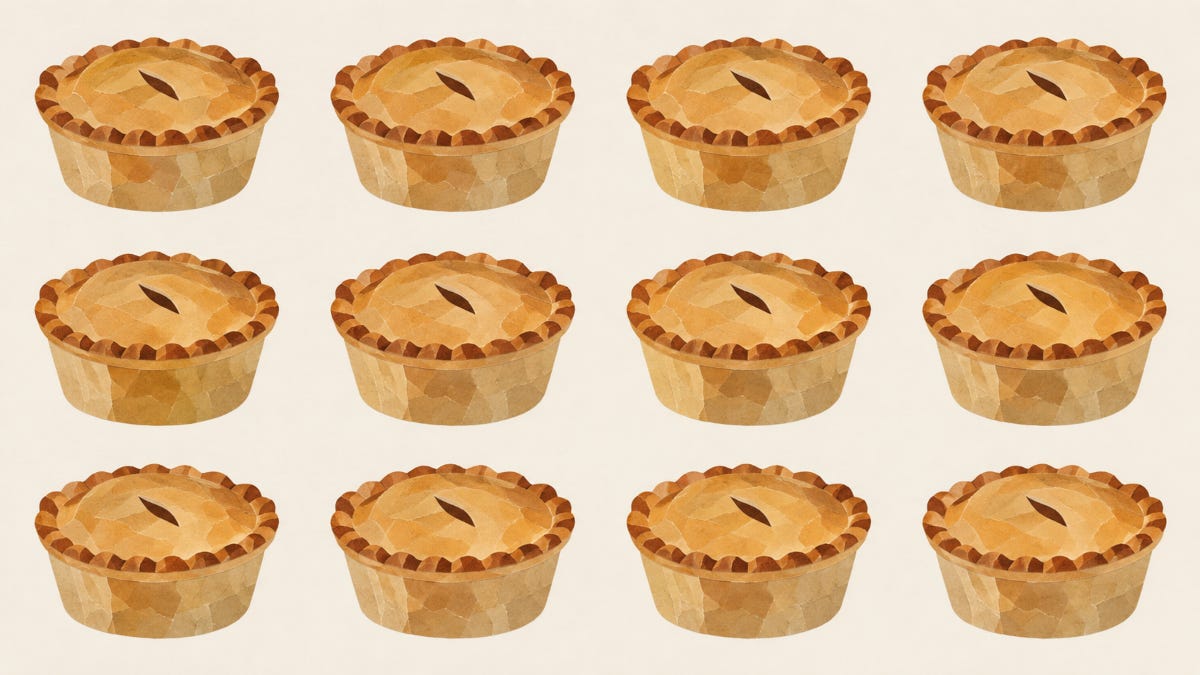
London’s first pie and mash shop opened in 1844, but neither pies nor mash looked quite like they do today. Early East End pies were filled with eels, many brought in by Dutch fishing boats, before overfishing made shops switch to beef. Mash was added only decades later. Even the trade itself was built on migration: two of its three founding families, the Cookes and the Manzes, were Irish and Italian.
A piece of blue glass on a 2,000-year-old British chariot fitting probably came from Egypt. Scientists analysing the bronze object at Diamond Light Source found that its red glass was typical of Iron Age Britain, but the blue glass had a chemical composition that points to Egypt. They think it was imported as beads and then reworked by a local craftsperson, meaning materials were travelling thousands of miles before the Roman conquest of Britain even began.
People care more about being exactly right than about being less wrong. In prediction experiments, researchers found that people often preferred forecasts with a higher chance of hitting the exact answer, even when those forecasts also carried a greater risk of a large error. That differs from how many forecasting systems and AI models are built: they usually try to minimise average error.
Most readers leave when they hit a paywall. Scientists analysed 209 million page views at a major US newspaper and found that 59% left immediately, while only about two in 1,000 subscribed on the spot. But paywalls still worked: readers who encountered one were 84 times more likely to subscribe than otherwise similar readers who did not. About one in ten also managed to get around the paywall, usually by opening the article in private browsing mode or clearing their cookies. By the way, Hypertextual has no paywalled articles, but if you enjoy it and want to support my work, please consider subscribing.
What I’ve been reading
In defense of the detour: “I don’t believe that using A.I. in the creative process would have gotten us these results. These systems are trained on billions of images, lines of text and designs. They produce responses that may be of novel use but struggle to depart from patterns found in or interpreted in existing materials and ideas.”
AI agents are rewriting the economics of computing: “More difficult for companies is the unpredictability of those costs. The study on agentic token consumption found that token use could vary sharply. Across repeated attempts of the same task, the most intensive run typically consumed twice as many tokens as the least, and in some cases 30 times as many. Human estimates of task difficulty were a poor guide, while frontier models also tended to underestimate how many tokens they would need.”
I went to America’s largest gathering of astrologers: “Like any sufficiently established field, modern astrology has developed its own hierarchies, factions and grudges. There are fights over tradition and fears about AI; impatient zoomers butting heads with baffled boomers; older men with reputations for harassment; and quieter epistemic disputes.”
Thanks for reading! If you enjoy the newsletter, share it with a friend or ten. And if you really enjoyed it, consider upgrading to a paid subscription to support my work.
Elia Kabanov is a London-based science writer exploring technology, cities, nature and history (@metkere).